


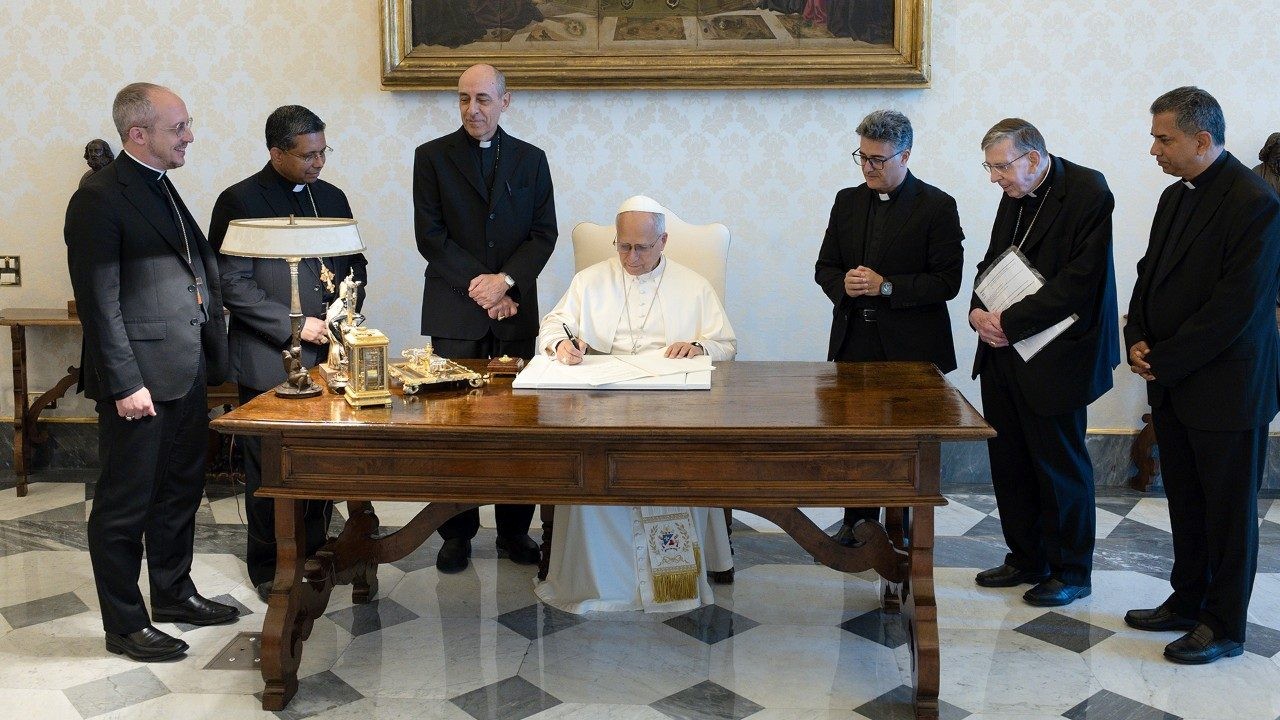
A rejection of anti-Semitism, Islamophobia, and any form of religious discrimination. The possibility of forging a common path, preserving mutual differences and—why not?—highlighting unequal treatment. A worldview that does not focus on a single religion or a universal brotherhood of religions, but rather on the possibility of religions working together. The statement, ” A Path of Hope,” signed by the Vatican Dicasteries for the Doctrine of the Faith, for Christian Unity, and for Interreligious Dialogue, highlights the Church’s ongoing commitment in these areas, beginning with the Second Vatican Council. But at the same time, it indirectly highlights how dialogue can be a diplomatic tool.
To be clear, the document is not an international relations document; it does not address international relations, and it is not intended as a response to the international problems of our time. However, the document cannot ignore the existing tensions and the role religions play on the global stage. Moreover, it is based on fairly solid foundations.
Religions and dialogue
For example, the Holy See and Saudi Arabia do not have diplomatic relations. But when, in 2012, Saudi Arabia established KAICIID, its international center for the study of interreligious dialogue, the Holy See did not hesitate to participate as an observer country, appointing a delegate from the Dicastery for Interreligious Dialogue to the board.
The same dicastery, then the Pontifical Council, did not hesitate in 2014 and 2015 to issue two statements in response to the situation that had developed in the Gulf, and in particular the rise of ISIS. These statements, first of all, called on dialogue partners to condemn the violence of the so-called Islamic State, and then emphasized that interreligious dialogue was necessary now more than ever.
Nor should we forget the interreligious prayer meetings for peace, first launched in Assisi in 1986 by John Paul II. The Polish Pope will return to Assisi in 2022, while Benedict XVI will do so in 2011, on the 25th anniversary of the first meeting.
More recently, the Declaration on Human Fraternity, signed by Pope Francis and the Grand Imam of Al-Azhar in Abu Dhabi on February 3, 2019, provided a clear reference point for continuing the dialogue. During his trip to Iraq in 2021, Pope Francis also looked to Shiite Islam, in an important meeting with Grand Ayatollah al-Sistani, which opened the possibility of a Day of Coexistence in Iraq, and a path similar to the one that led to the Declaration on Human Fraternity.
But many other situations should be mentioned, which do not concern only dialogue with Islam. For example, the prudence and equidistance with which the Holy See has viewed the so-called “Orthodox schism,” that is, the Ukrainian Orthodox Church’s request for autocephaly, completely rejected by the Moscow Patriarchate. Moscow, in fact, abandoned all dialogue discussions co-chaired by the Patriarch of Constantinople, who had granted independence, but has never “severed” relations with Rome; in fact, Archbishop Paul Richard Gallagher, Vatican Secretary for Relations with States, did not fail to visit the Patriarchate’s headquarters during his recent trip to Moscow.
And again, relations with the Jewish world, which have remained strong even when there have been profound disagreements over the situation in the Middle East. Because where diplomacy struggles, a strong dialogue remains, which also involves recognition of the State of Israel, a sine qua non of Vatican diplomacy, and an ever-present theme even when the Holy See has not failed to condemn the situation in Gaza.
Where diplomacy struggles, interreligious dialogue creates a foundation, a possibility for discussion, even a path to peace. A reasonableness of faith remains present, and an unreasonableness lies in considering international relations without considering the religions on the ground, as Benedict XVI also noted in his highly contested Regensburg lecture in 2006.
Il Foglio rightly noted – as cited in the document released on September 16- to underline that the season of controversy is also over and that today it is possible to look to the past with greater serenity.
The themes of the document: “A path of hope”
But where does the document originate? It was released as part of the celebrations for the 60th anniversary of the Conciliar Declaration Nostra Aetate. Born as a document that sought to define and reevaluate the relationship between Christianity and Judaism, Nostra Aetate has , in reality, become the cornerstone on which interreligious dialogue has been built over the last sixty years. The document, in fact, addressed relations with all other Abrahamic faiths.
The document “ A Path of Hope” clearly highlights that for Christians there are no “two ways of salvation,” because Christ is the only redeemer, but rather an irrevocable alliance with the Jewish people remains, a solidarity that also includes the fight against anti-Semitism.
The document states that “the conflicts that have erupted in the Middle East in recent years have also left their mark on Jewish-Christian dialogue. Many bridges of communication have faltered and continue to be tested by differing interpretations of subsequent events, often conflicting even within the respective religious communities . However, the pillars of dialogue among believers, built over sixty years of joint work, have remained firm. It is possible and necessary to build upon them, continuing to draw inspiration from the Council Fathers’ recommendations to grow in mutual understanding and esteem ‘above all through biblical and theological studies and through fraternal dialogue.'”
The document also underlines that “in some regions, relations between believers of different religions are historically conflictual, and the memory of ancient wounds makes mutual trust difficult, despite the exhortation of the Declaration Nostra Aetate. “ to forget the past and to sincerely strive for mutual understanding”, especially between Christians and Muslims ”.
We therefore recall the words of Pope Francis, who stated that ” we Christians should welcome with affection and respect the Muslim immigrants who arrive in our countries, just as we hope and pray to be welcomed and respected in countries of Islamic tradition . I pray, I humbly implore these countries to ensure freedom for Christians, so that they can celebrate their worship and live their faith, taking into account the freedom that Muslims enjoy in Western countries! “
‘s words , contained in the 2014 apostolic exhortation Evangelii Gaudium , highlight the principle of reciprocity, fundamental to international relations . Religious freedom, tolerance, and respect for faith cannot be one-way definitions, practiced only by one of the parties in dialogue, but must exist in reciprocity.
At number 52, the document emphasizes that ” the future of interreligious dialogue today requires renewed reflection and particularly clear commitments,” as new challenges arise. The document notes that “identity tensions, community closures, fundamentalist ideologies, conflicts with religious connotations, the political manipulation of religion, but also the growing indifference in many countries toward any form of spirituality, require us to renew the modalities of dialogue in a rapidly changing world.”
The solution, for the Holy See, is not to “establish a great world religion in which all beliefs are leveled. This possibility must be ruled out out of respect for oneself and others. Instead, it is about building a fraternal society capable of accepting differences .”
In this regard, it should be remembered that the initiative for the Parliament of Religions, launched in the 1970s, attempted to shed new light, encouraged by then-Israeli President Shimon Peres, who presented Pope Francis with the possibility of the Holy See’s participation. This possibility was rejected, not so much because the Holy See does not believe in dialogue, but because dialogue with religions cannot be reduced to a “quasi-political” issue.
Dialogue – the document underlines – “ does not consist only in expounding one’s own doctrines or comparing one’s own worldviews ”, because “today, faced with those who foment divisions and prepare conflicts, believers of different traditions, and first and foremost their leaders, aware of their irreconcilable differences, are called to seek, with lucidity and hope, the conditions for peaceful coexistence”.
The Holy See calls for ” a true transformation of mentalities: abandoning the logic of defense, hostility, or conquest, to adopt an open, benevolent, and courageous attitude. Monolithic and isolated models, which encourage a closed vision of reality, prove increasingly inadequate and ultimately a source of violence and suffering for the weakest.”
There are two reference documents. The first is the document Dialogue and Mission, which ” affirms that dialogue is an integral dimension of the Church’s evangelizing mission, while specifying that it does not replace the explicit proclamation of Christ, but rather accompanies and enriches it.” The second is the document Dialogue and Proclamation, which ” deepens the reflection on the relationship between interreligious dialogue and the explicit proclamation of the Gospel. While clearly recalling that the proclamation of Christ remains the heart of the Christian mission, it emphasizes that interreligious dialogue is not only compatible with this proclamation, but constitutes an essential and complementary dimension.”
The impact on international relations
How could all this affect international relations?
First of all, because religions represent communities, they are an integral part of their nations’ identity, and therefore, dialogue between religions creates the possibility of encounter that diplomacy often fails to bring . Dialogue between religions is a dialogue that takes place at the grassroots, rather than at the summit. The trust that builds between people of different faiths represents the basis for a potential path of dialogue at the diplomatic level.
And this is especially evident in common practice. The ISIS invasion was dramatic precisely because it broke the “pact of trust” of the Iraqi population, and close friends denounced the Christian families, who were then forced to flee. For this reason, the Pontifical Council for Interreligious Dialogue asked the dialogue partners to express a clear condemnation. This was needed to rebuild credibility and establish dialogue on a foundation of mutual trust.
Therefore, considering religions as part of the framework also allows us to look more deeply at local situations. Religious beliefs impact public life, both when it’s obvious— think of the use of the hijab in some Islamic countries —and when it’s less obvious. Religious communities are spaces of freedom, not lawless communities, and places where people express themselves. Ignoring this is losing sight of the people. And, while every diplomatic relationship is nourished by trust between leaders, no peace or relationship can be maintained without a genuine connection between people, which also involves religious identity .
Third, because the path to peace begins, first and foremost, with understanding others. Religions bring not only understanding, but also the ability to forgive and to overcome adverse narratives and histories. You can’t change history. You can change how you build the future. And religions are perfectly capable of doing so.
In this sense, the document “A Path of Hope” also fits into the work carried out by the Holy See at the international level. The Holy See’s diplomacy is also a diplomacy of dialogue, and such a document helps define the pillars of this dialogue.