


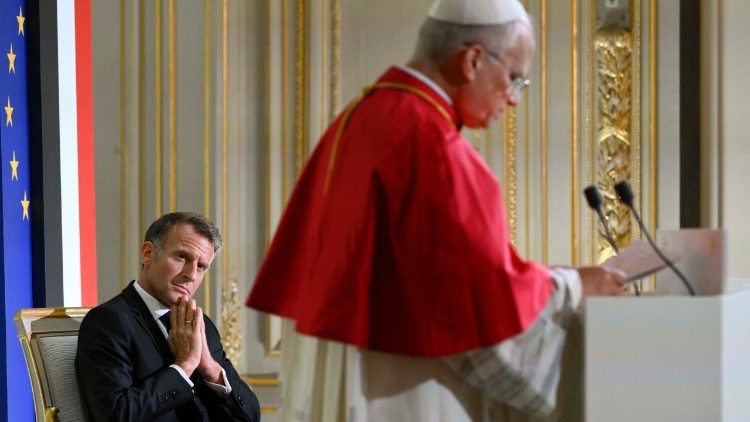
Leo XIV’s trip to France, from September 25 to 28, sparked widespread resonance. The 800,000 people who gathered for Mass in the Place de la Concorde , a symbolic site of the French Revolution, testified to a strong religious presence of a people searching for God. A search for God that arises in a mysterious way, so much so that the ecclesiastical community of the Île -de-France region , which includes the Archdiocese of Paris, convened a regional council to understand why adult baptisms are continually increasing—of the 21,000 baptized on Easter night 2026, 13,000 were adults—and why people are returning to the faith.
This search for God takes place in a deeply secularized country. French President Emmanuel Macron, at the beginning of his first presidential term, on April 11, 2018, went to the College desBernardins , the “temple” of Catholic culture in Paris, and proposed his model of healthy secularism, asking Catholics to offer three gifts to French society: their wisdom, their social and political commitment, and their spiritual freedom.
The healthy secular approach, however, has not prevented the Elysée from ignoring the requests of the French bishops. First, in 2024, a controversial paragraph was inserted into the Constitution emphasizing that “the law determines the conditions under which the freedom guaranteed to women to have abortions is exercised.” It is a sort of “softened right to abortion,” the result of a compromise, but nevertheless enshrined in constitutional law.
Then, in 2026, shortly before the Pope’s trip, France enacted a law on the end of life that—the bishops denounced —effectively excludes the possibility of conscientious objection for certain groups. Not only that, but it is also an assisted death. Institutions that condemn the practice of assisted dying still risk being forced to provide it .
This alone would be enough to understand how the visit to France entailed particular political and diplomatic risks. Yet, France responded extraordinarily to the Pope’s visit, and faced with this popular response , even French President Macron had to bow. First, he said he would not attend any Mass, as previous French presidents had not done, out of respect for the principle of secularism , but then he nevertheless attended the Pope’s final Mass in Metz. He tried to award the Pope the Legion of Honor , but the Pope never accepts individual recognition. He tried to offer the Pope a state lunch or dinner, but the Holy See refused. He proposed spending ten minutes with the Pope to show him the restoration of Notre-Dame , but the Pope made it clear that the visit to the restored cathedral had to be fully spiritual in nature ( all of this was documented in a report in the French Catholic newspaper La Croix ).
There were three high points of the Pope’s visit: the address to the diplomatic corps and civil authorities at the beginning of the trip, on September 25 ( the full address here ); the address to UNESCO, which has its headquarters in Paris, also on September 25 ( the full address here ); and finally the address in Metz, as part of the meeting “At the Roots of Europe for Peace and Unity” ( the full address here ), preceded by an address to religious representatives ( the full text here ). But there was also a very strong appeal for life during the meeting with the workers and patients of the Accueil Notre Dame in Lourdes on September 27 ( the full address here ).
Returning from the trip, during the press conference on the plane ( full text here ), Leo XIV clarified that there is a separation between Church and State and that the Church does not engage in politics. But he also noted that he was very aware of the situation in France, and that the Church cannot refrain from intervening when the values of human life are at stake.
What can we glean from such a rich journey? Three guiding principles: the weight of religion in public life, the role attributed to science, and the need to build communities and put humanity back at the center.
- The weight of religions in public life
Speaking to UNESCO, Leo XIV stated that religions cannot be excluded from public debate because they express people’s views on life and death. Speaking in Metz, before various religious denominations, he called on all religions to defend life. In his address to the French diplomatic corps, Leo XIV reiterated the need for a healthy secularism that does not exclude religious activity. Leo XIV vigorously promoted the return of God to public life, and he did so with an extraordinary response. In France, hundreds of thousands attended each celebration, as had been the case during his trip to Spain. In the face of secularization, there is a world searching for faith, and Leo XIV asks that it not be ignored. It is no coincidence that, in his address to the diplomatic corps, the Pope cited France’s Christian roots, showing that France’s cultural grandeur could not have arisen without faith. It’s no coincidence that, at UNESCO, the Pope referred to the Catholic Church’s educational work. Religion, wherever it spreads and establishes itself, creates culture. Culture is the greatest antidote to religious ignorance and the first antidote to conflict.
- The role attributed to science
Faced with the French Revolution’s idea of “Reason”—and Notre Dame was also dedicated to the Goddess of Reason when the French Revolution took hold— Leo XIV responded by warning against the temptation to rely on science for every form of comfort. And this was an opportunity for the Pope to also condemn the idea of “programmed deaths” as a great scientific achievement. Indeed, at Lourdes he went so far as to note that medicine’s task is to care for the suffering, completely rejecting the logic that treats the human person as waste.
But the theme of science also becomes central when discussing artificial intelligence. At UNESCO, the Pope noted that artificial intelligence systems are, indeed, capable of correlating data, but they cannot answer questions of meaning, and “human beings cannot live without meaning. Meaning is the oxygen of the mind.”
Again at UNESCO, Leo XIV noted that the human being is first and foremost a person who is born, thus shifting attention not to possibilities, but to the intrinsic dignity of man. No science, ultimately, is capable of granting man the fundamental rights he possesses by the mere fact of existing.
- The need to build communities and put people back at the centre
Leo XIV called on young Europeans to be community builders. All his speeches on French soil were, in some way, concerned with putting the human being, with his inherent dignity, back at the center and giving meaning to humanity by placing faith and religious convictions at the center. This is a revolutionary theme in a country of secularism and the total separation of Church and State.
But it’s a theme also inspired by the memory of Robert Schuman, the great European statesman who envisioned the European Community as building something in which war was “unthinkable,” repairing relations between states and integrating them into a community. If there is no competition, but cooperation, then there is no reason to wage war. Schuman’s declaration came in 1950, and it was revolutionary because it sought to bring together two ancient enemies, France and Germany, who had emerged from the Second World War only five years earlier. And yet, the project worked .
Leo XIV thus sent a very clear message not only to France, but also to Europe. It continues the message he sent during his trip to Spain in June 2026 and, in some ways, offers a key to understanding Leo XIV’s pontificate.